
Checking lesson · Menus and kitchen
One recipe, written down twice
A chef's handwritten ciabatta sheet, photographed in April 2026, and a printed recipe card for the same bread, made in June. They disagree on almost every line, and the card even disagrees with itself on the bake.
From recipe documentation for Ālaya Café & Bar in Shillong, a Breakthrough Design Studio project, shared with permission.
1
The material
Two documents for the same bread. Here is what each one shows.
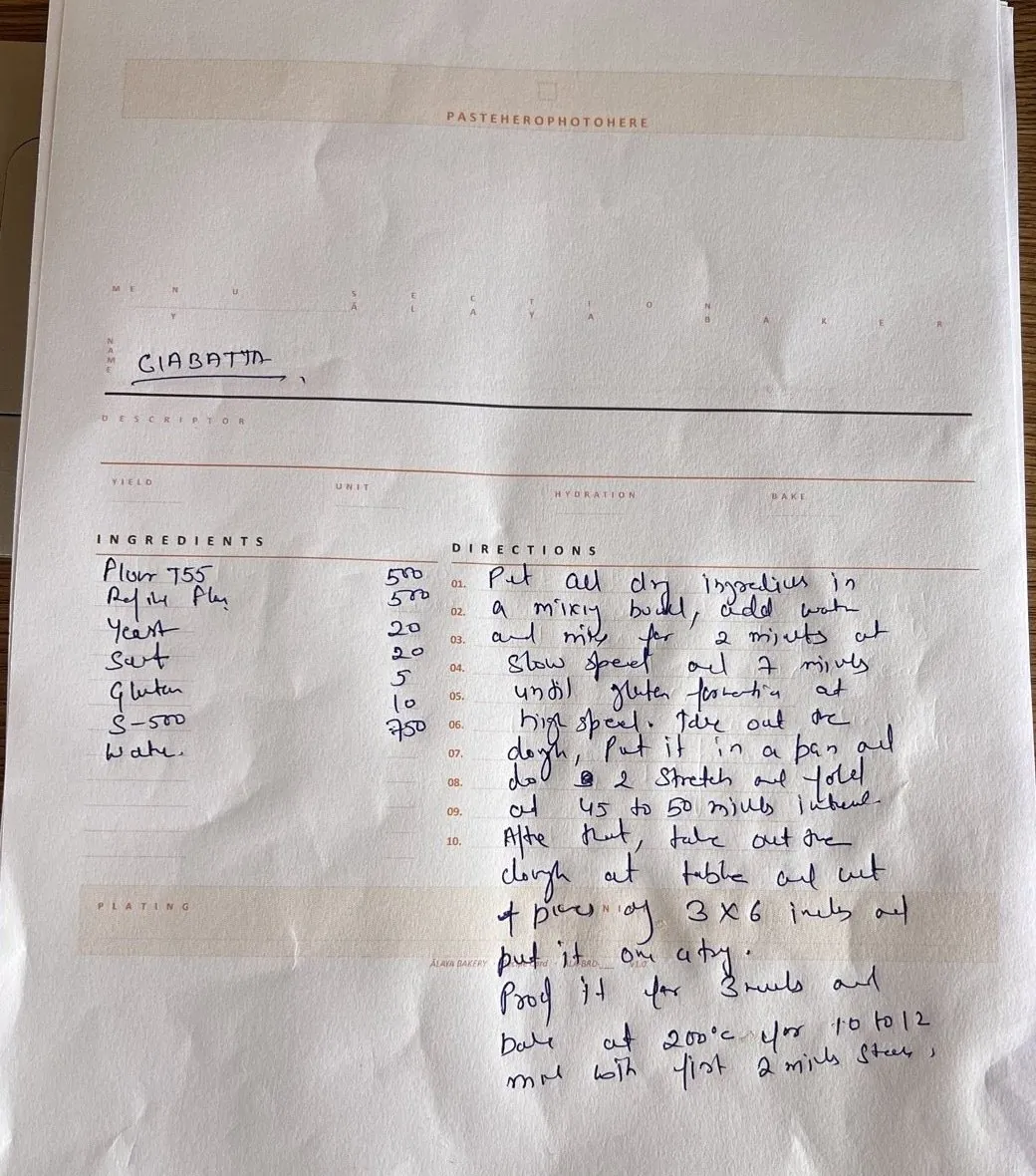
The chef's handwritten sheet (photographed April 2026). One pen mark: the stray 750, one line above the water line, which has no number. 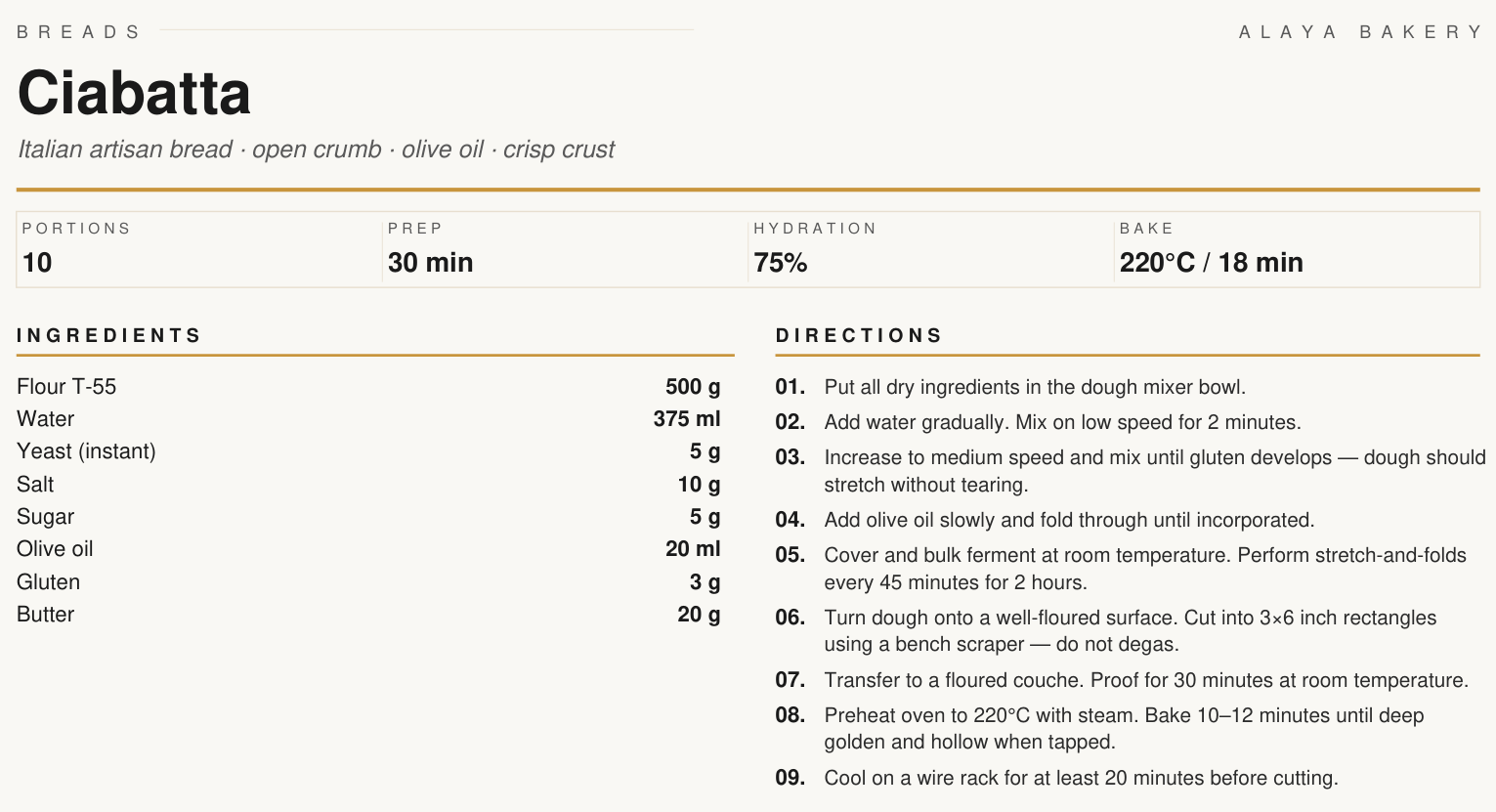
The printed recipe card made later (June 2026) 2
The method
The Recipe Card Starter’s first prompt turns notes into a card with a fixed structure. These are its rules, quoted from the guide:
- Use only what is in the notes. Do not invent, estimate or "standardise" any quantity, temperature, time or ingredient.
- Where something is missing, vague ("a pinch", "to taste", "a good piece") or contradictory, write MISSING or UNCLEAR in that field.
- Convert units only when the notes give an exact amount, and show the original next to the conversion.
- After the card, list every MISSING or UNCLEAR item as a numbered question for the chef.
3
What the method produces
A card that keeps only what the sheet says, with each gap marked MISSING or UNCLEAR and a numbered question for the chef, instead of a guessed quantity. We haven’t published an output for this sheet: one is shown only after the chef has checked it.
4
The human checks
The chef answers each question, the card is filled in, and the chef signs it off before the team cooks from it.
- Every ingredient has a quantity and a unit
- Yield and portion add up
- Allergens are listed and checked by a person
5
What it’s for
A card the team can follow without asking, with every number traced to its source. The aim for the operator: fewer repeated explanations in the kitchen and more consistent preparation.
The two documents, line by line
This is only what the two documents show. Why they differ isn’t recorded here.
| Item | Chef’s handwritten sheet | Printed recipe card |
|---|---|---|
| Flour | T55 500 + refined flour 500 | T-55 500 g only |
| Yeast | 20 | 5 g (instant) |
| Salt | 20 | 10 g |
| Gluten / improver | Gluten and S-500 improver; 5, 10 and 750 don't line up with the names | Gluten 3 g; no improver |
| Water | No number on its line (750 sits one line up) | 375 ml |
| Sugar, olive oil, butter | Not on the sheet | 5 g, 20 ml, 20 g |
| Units | None written | Grams and millilitres |
| Proof | "3 …" on a tray (hard to read) | 30 minutes in a couche |
| Bake | 200°C, 10–12 min, steam for the first 2 min | 220°C / 18 min in the header; 10–12 min in step 8 |
| Allergens | Not recorded | No allergen field |
The printed card looked finished, but nothing on it showed where its numbers came from. A card your team cooks from needs every number traced to its source and a chef's sign-off.